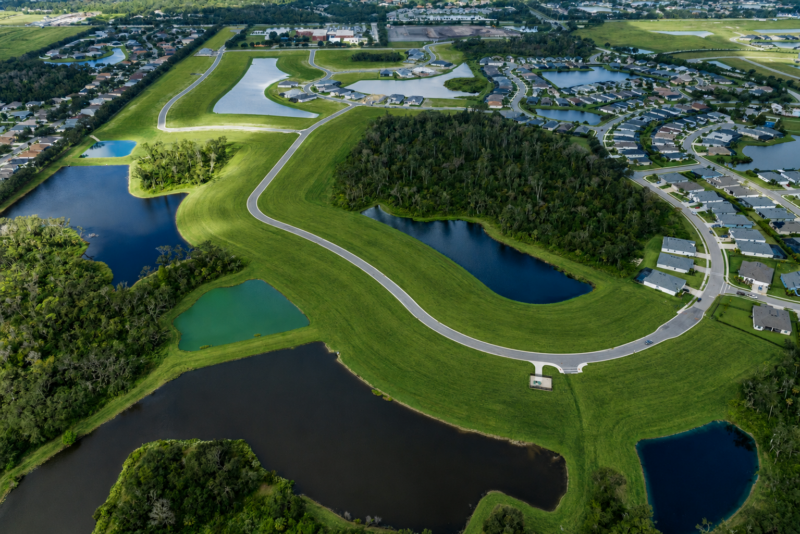
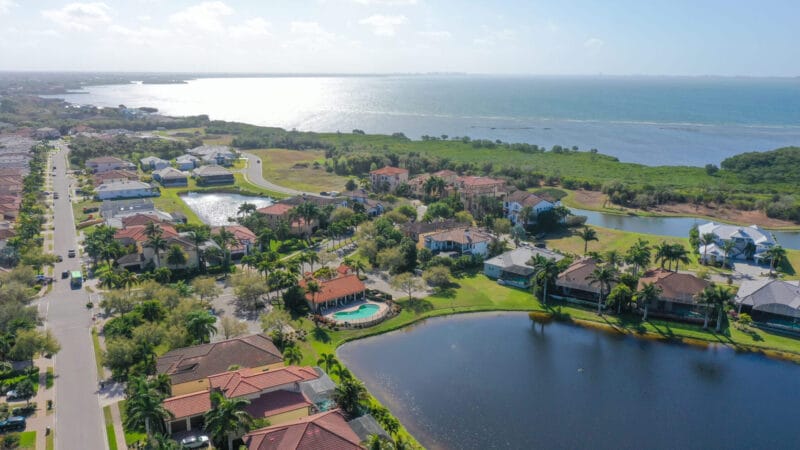
There is a reason waterfront is the most sought-after address in Manatee County. Morning light coming off Sarasota Bay, water views from the kitchen, a beach a few minutes from the front door. Standing on a homesite with the bay in front of you, the decision tends to make itself.
The good news is that everything else is knowable. Flood zones, a separate insurance policy, what you may build off your own shoreline, and how a home is built to handle salt air are all questions with clear answers, and getting those answers early is what turns a great view into a great long-term purchase.
Waterfront living here is worth it. Going in informed is simply how you enjoy it without surprises.

Key takeaways
- Flood insurance is a separate policy. Standard homeowners insurance does not cover flood damage.
- Roughly one third of national flood insurance claims come from outside high-risk flood areas, so the zone on the map is a starting point, not an all-clear.
- Private docks in Florida have square-footage thresholds. Exceed them and you move from a free self-certification into a paid permit.
- Impact-rated windows and doors are not a luxury on the water. They protect the home and earn insurance credits.
- Bradenton offers two distinct ways to live on the water: direct Sarasota Bay frontage at Legends Bay, or lagoon and beach living at Aqua.
What Should I Know Before Buying a Waterfront Home in Florida?
Before buying a waterfront home in Florida, confirm the property’s FEMA flood zone, budget for a separate flood insurance policy, and verify what you may build on the shoreline. Docks and seawalls need state and local approval, and salt air accelerates wear on roofing, fixtures and HVAC. Newer construction with impact-rated openings typically insures better.
Each of those is worth a few minutes before you make an offer. Here is what each one actually involves.
Start With the Flood Map
Every property in the United States sits somewhere on a Flood Insurance Rate Map. You can look yours up for free at the FEMA Flood Map Service Center, which FEMA calls “the official public source for flood hazard information.”
Do this before you get attached to a specific homesite, not after. It takes about a minute.
Two things to understand about what you find.
First, flood maps change. FEMA updates them, and a zone designation is a snapshot rather than a permanent fact about the land. Print or download the map you relied on and keep it.
Second, and this is the part buyers get wrong: a low-risk designation is not a guarantee. According to the National Flood Insurance Program, “almost one-third of NFIP flood insurance claims come from outside high-risk flood areas.” Water does not read the map.
Flood Insurance Is a Separate Policy
This is the single most common misunderstanding in coastal buying, and the NFIP states it plainly: “Most homeowners insurance does not cover flood damage. Only flood insurance covers the cost of rebuilding after a flood.”
So a waterfront budget has two insurance lines, not one. Your homeowners policy, and a flood policy on top of it.
If your property sits in a high-risk zone and you are financing, your lender will almost certainly require flood coverage. If it does not, you may still want it, for the reason above.
Get both quotes before you contract, not after. Insurance is a monthly cost for as long as you own the home, and it belongs in the affordability math from the beginning rather than arriving as a surprise at closing.
One thing that works in your favor with new construction: roof shape, roof-to-wall connections, impact-rated openings and secondary water resistance each earn separate credits on a Florida policy. A wind mitigation inspection documents them. Make sure your carrier applies every credit the home qualifies for.
Docks, Seawalls, and What You Can Actually Build
Owning shoreline is not the same as being free to build on it. Structures over the water are regulated by the state, and in most cases by your local government too.
The Florida Department of Environmental Protection publishes the thresholds for a private single-family dock. The exemption depends on the waterbody:
| Water type | Exempt dock size | Limit |
| Outstanding Florida Waters | Up to 500 sq ft of over-water surface | One private noncommercial dock |
| Canals and waters outside Outstanding Florida Waters | Up to 1,000 sq ft of over-water surface | One private noncommercial dock |
Within those limits, self-certification through the DEP Business Portal is free. Beyond them you move into paid permitting: $100 for an exemption verification, $250 for a general permit, and $420 as the base fee for an individual Environmental Resource Permit.
Design rules apply too. For single-family installations, DEP limits the access walkway to a maximum width of four feet and the terminal platform to 160 square feet.
The practical takeaways for a buyer:
- Find out which category your specific waterbody falls into before you assume a dock size. The designation drives the threshold, and it is not obvious from looking at the water.
- Ask whether a dock, seawall or boat lift already exists, who maintains it, and what condition it is in. Seawall repair is expensive and it is rarely optional.
- Ask what the community itself provides on the water, and what it does not. Shared shoreline amenities and private boat access are two different things, and the difference belongs in your plans before you buy.
What Salt Air Does to a House
Living on the water is harder on a building than living a mile inland. Salt accelerates corrosion, humidity is relentless, and sun exposure on an open waterfront homesite is unfiltered.
What that means in practice: exterior fixtures, fasteners and hardware corrode faster. HVAC condensers work in a harsher environment. Roofing and exterior finishes face more UV and more wind-driven rain.
None of this is a reason to avoid the water. It is a reason to care about what the house is built from. Materials chosen for coastal exposure, impact-rated windows and doors, tile roofing where it fits the design, and construction standards that exceed Florida Building Code requirements all pay for themselves over time on a waterfront homesite in a way they might not five miles inland.
Ask any builder what is standard versus what costs extra. On the water, that list matters more than the base price.

Two Ways to Live on the Water in Bradenton
Waterfront is not a single product, and the choice between these two is the real decision most Bradenton buyers are making.
| Factor | Legends Bay | Aqua |
| Water | Over a mile of Sarasota Bay shoreline | Private 4-acre lagoon with sandy beach, near Sarasota Bay |
| Home types | Single-family, semi-custom and custom | Townhomes and single-family |
| Dock access | Observation dock, no boat slips | No private docks |
| Entry pricing | Waterfront homesites from $800,000, homes from $2,900,000 | Townhomes from $850,000, single-family from $1,000,000 |
| Best for | Buyers who want direct bay frontage and a semi-custom or custom home | Buyers who want water and beach without shoreline obligations |
| Setting | Gated, clubhouse and resort-style pool | Gated, courtyard-focused designs |
Legends Bay is the bay-front option. Over a mile of Sarasota Bay shoreline, a gated setting with a clubhouse and resort-style pool, and an observation dock for taking in the water. Homes are semi-custom and custom. Waterfront homesites are priced from $800,000, with individual sites currently listed from $825,000 to $1,875,000 depending on position, and completed homes from $2,900,000.
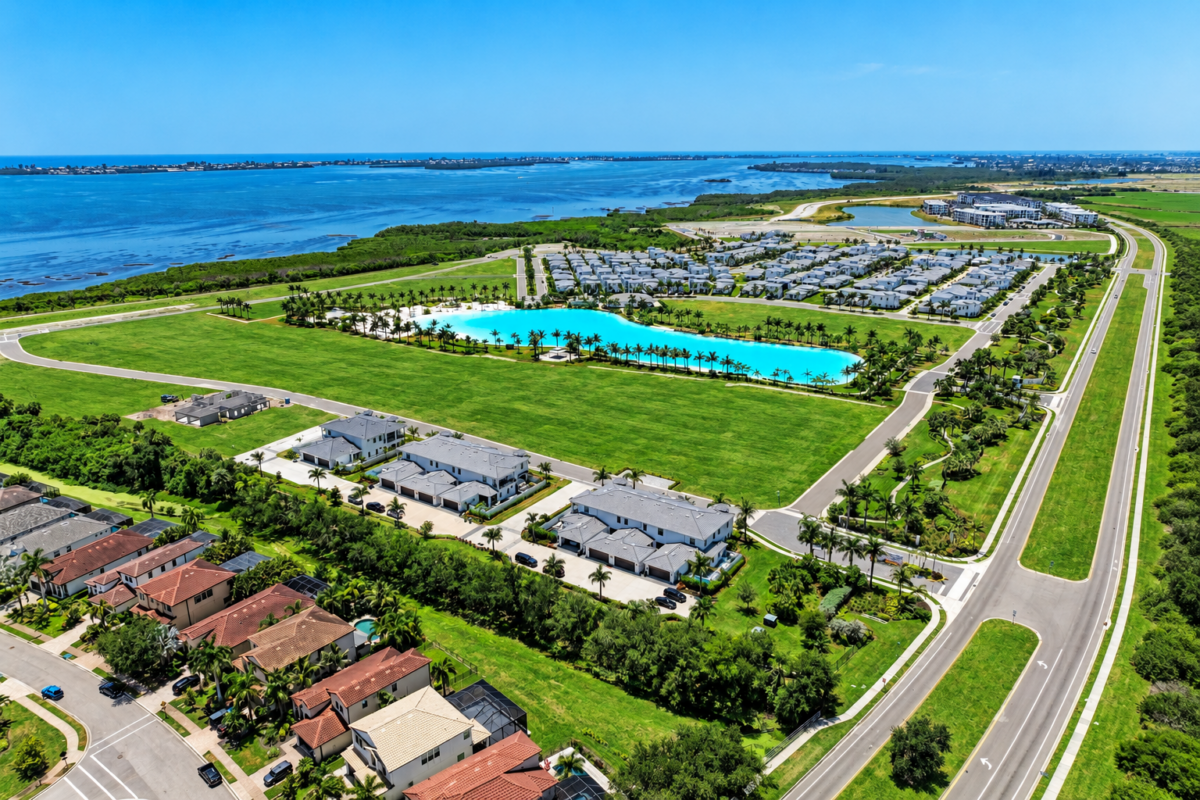
Aqua takes a different approach: a private four-acre lagoon with a sandy beach, near Sarasota Bay, in a gated community of townhomes and single-family homes with courtyard-focused designs. You get water and beach as everyday amenities, with less of the maintenance that comes with owning open shoreline.
Both sit in West Bradenton, near Longboat Key and Anna Maria Island, with IMG Academy and Sarasota-Bradenton International Airport close by. Both include impact-resistant windows and doors, quartz countertops, Samsung appliances, eight-foot interior doors and epoxy-sealed garage floors as standard rather than upgrades.
Questions to Ask Before You Sign
- What is the FEMA flood zone for this exact parcel, and when was the map last updated?
- What will flood insurance and homeowners insurance cost on this specific home?
- Has a wind mitigation inspection been done, and which credits does the home qualify for?
- What may I build on the shoreline, and does the waterbody’s designation affect the dock threshold?
- If a seawall, dock or lift exists, who owns it, who maintains it, and what condition is it in?
- Which exterior materials were selected for coastal exposure?
- What is standard versus an upgrade, in writing?
Frequently Asked Questions
What should I know before buying a waterfront home in Florida?
Confirm the FEMA flood zone, budget for a separate flood insurance policy, and verify what you may build on the shoreline. Docks and seawalls need state and local approval, and salt air accelerates wear on roofing, fixtures and HVAC.
Does homeowners insurance cover flood damage in Florida?
No. The National Flood Insurance Program states that most homeowners insurance does not cover flood damage, and only flood insurance covers the cost of rebuilding after a flood. Waterfront buyers should budget for both policies.
Do I need flood insurance if my home is not in a high-risk zone?
It is worth considering. Almost one-third of NFIP flood insurance claims come from outside high-risk flood areas. Lenders typically require coverage in high-risk zones, but the risk does not stop at the zone boundary.
Are waterfront homes in Bradenton more expensive to insure?
Generally yes, because of flood exposure and wind risk. New construction usually prices better than older stock, since impact-rated openings, modern roof-to-wall connections and secondary water resistance each earn separate credits on a Florida policy.
What waterfront communities does Medallion Home build in Bradenton?
Legends Bay offers over a mile of Sarasota Bay shoreline with an observation dock, waterfront homesites from $800,000 and homes from $2,900,000. Aqua offers a private four-acre lagoon with a sandy beach, with townhomes from $850,000 and single-family homes from $1,000,000.
See the Water for Yourself
A flood map tells you about risk. It does not tell you what it feels like to have coffee looking at Sarasota Bay.
Both of our Bradenton waterfront communities are open for touring, with designer model homes and a sales team who can walk you through the specifics on any homesite: the zone, the insurance picture, what is included, and what you can build. Since 1984, Medallion Home has built along Florida’s Gulf Coast. Crafted with intention. Designed for you.
Book a tour of Legends Bay or Aqua today. If you are still comparing areas, our guide to building costs in Sarasota and Manatee breaks down the numbers county by county.
Explore our communities · See move-in ready homes · See the Medallion difference